Welcome to Mazdayasni Online!
We hope that your visit to Mazdayasni Online is full of enlightenment and understanding. Please, do not hesitate to contact us if you need more information. If it’s not on here yet, we can find a good resource for you. If you need help converting or wish to learn more about Zoroastrianismm, we’re here for you as well. We recommend you start with “The Sacred Gathas of Zarathushtra & The Old Avestan Canon”, a modern and accessible translation of the Gathas, the very words of Zarathushtra, and the Old Avestan Canon, composed by the first Mazdayasni community from Zarathushtra’s direct teachings. Below you’ll find a copy of our About page for your reference to get you started on your Ashavic Enlightenment!
What is Mazdayasna? Mazdaynasa, known as Zoroastrianism in the English-speaking world, is a complex, ancient, and diverse spiritual tradition that believes in Ahura Mazda as The One Above All and that there are various divinities that emanate from Ahura Mazda in the quest to perfect reality through choosing to attune with Asha (the mystical truth-force that is our birthright and permeates all) and the practice of its Threefold Path of Good Thoughts, Good Works, and Good Deeds. Interpretations may differ, but Zoroastrians are generally united in their Ashavic mission, which is by far more important than arguments on belief.
What is Mazdayasni Online?
Mazdayasni Online is primarily an infosite maintained by Mazdayasni scholar and convert Pablo Vazquez for those interested in learning more about Mazdayasna, adherents wanting to dig deeper into their faith, and the like. It was also created to help connect potential converts to trustworthy sources on their Mazdayasni path. If you’d like to help us out or need elucidation on something not currently presented on the site, please don’t be afraid to contact us!
As we look forward to the celebration of Nowruz, we hope that you enjoy reading this informative article, kindly contributed by fellow Zoroastrian and scholar Pablo Vazquez, about the festivals celebrated during what can be called the “Zoroastrian Holy Season”.
These festivals are:
Hamaspathmaidyem
Charharshanbe Suri
Frawardigan
Pateti
Nowruz
Khordad Sal
What are these festivals? How are they celebrated? What do they mean?
Hamaspathmaidyem:
This sacred festival, known as a Gahanbar, is one of the few that is mentioned in the Avestan texts showing that Zoroastrians had been taking part in it since time immemorial.
All Gahanbars were originally one-day festivals marking the end of a season in the old Zoroastrian reckoning, exemplifying the faith’s worship of nature and its course. They later became 5 to 10-day celebrations with Hamaspathmaidyem (etymology unknown) being traditionally the longest at 10 days. It is a religious festival meant to celebrate us, humanity, and the creative activity of Ahura Mazda and the Amesha Spenta, particularly Spenta Mainyu, towards whom we are grateful for our existence.
It was originally celebrated on the day before Nowruz which in the Northern Hemisphere would be the day before the Spring Equinox meaning it would fall on March 19th or the 20th in the Gregorian calendar. The later celebration over a longer period led to the festival being broken in half by Charharshanbe Suri (see below) which marks the start of Frawardigan or the “Gathas Days”. These last five days Hamaspathmaidyem are only celebrated during the day.
Continuously celebrated in Iran and other Zoroastrian Persianate regions, Hamaspathmaidyem and other Gahanbars are experiencing a mild revival in celebration among Parsis. We know that these days were marked by feasting and community gatherings along with ritualization and prayer, all of which have continued as traditions for Hamaspathmaidyem.
Charharshanbe Suri:
Nowadays, especially in the Zoroastrian diaspora, the Gahanbars have fallen out of favor and, as such, Charharshanbe Suri (“Scarlet Wednesday”) is usually considered the “start” of Nowruz celebrations and takes place the Tuesday evening before the Wednesday preceding Nowruz.
As previously mentioned, its origins may have marked a mystical transition between the two halves of the Hamaspathmaidyem Gahanbar to provide a celebratory welcoming of the Fravashi and all other divinities welcomed during the Zoroastrian Holy Season.
Its name comes from the pervasive use of fire during the celebrations and central celebration of the coming of a bright new year at Nowruz with the ending of Winter. It is mostly celebrated by Iranian Zoroastrians and Zoroastrians in other Persianate regions and is only celebrated by a minority of Parsi Zoroastrians. Charharshanbe Suri celebrations are traditionally and wonderfully raucous involving constant fire jumping and bonfire making, costumed noise-making reminiscent of Euro-American traditions of trick-or-treating on Halloween, pot smashing rituals to ritually transfer misfortune to the pot to destroy it, romantic courting traditions involving precarious chimney ropes, eating large amounts of auspicious snacks and meals, and, of course, the burning of various things especially incense and rue seeds to ward off curses and malevolent entities.
Frawardigan/“Gatha Days”:
While disputes have existed throughout the history of the faith as to the actual length of this holy festival, nowadays it is either celebrated concurrently with the Hamaspathmaidyem Gahanbar in the evenings or only on the last five days of the Gahanbar in the evenings.
Zoroastrianism is somewhat unique in its overlapping festivals and nowadays the contention as to the length of Frawardigan has been mostly pushed aside for community harmony amongst the Zoroastrian community worldwide.
Frawardigan is considered the time where the veil between the material and spiritual realms is as “thin” as it can be and, as such, it is reminiscent of Mexican celebrations of Day of the Dead with the celebratory welcoming of the holy Fravashis of family, friends, cultural heroes, religious saints, and so forth along with any other divinities. Most of the intensity of these celebrations take place the last five days before Nowruz which usually falls on the evenings of March 16th to the 20th on the Gregorian calendar. These days are usually known as the “Gatha Days” due to each day bearing the name of one of Zarathushtra’s Gathas where all Zoroastrians are encouraged to read, study, discuss, and contemplate each Gatha on its namesake day.
Amazing feasts, along with incense, flowers, and candles/fires, are set out for the Fravashi and other divinities to join the materially-living in feasting, comfort, and celebration. As has been commented on by theologians throughout the faith’s history, Zoroastrians are called to celebrate the dead and to not mourn due to either a strong belief in death being merely an illusion impeding a transition, or of mourning causing worry to the Fravashi of the deceased.
Pateti:
The last day of Frawardigan and Hamaspathmaidyem Gahanbar (thus usually March 20th on the Gregorian calendar), Pateti literally means “day of confession” and Zoroastrians are encouraged to spend some time of their day engaged in introspective meditation about the past year, especially in how they can better follow the Path of Asha. Though having fallen out of favor in some communities during modern times, it is nonetheless common to see Zoroastrians encouraging each other to reflect on their thoughts, words, and deeds during Pateti.
Practices on Pateti include constant prayer at home or fire temples, silent meditations on one’s actions throughout the year, and, if need be, apologies for previous missteps and harm caused with a commitment to remain, as best as possible, on the Path of Asha.
Nowruz:
The most important day of the Zoroastrian calendar, this “new day” (the meaning of the word Nowruz) is a celebration of the year to come, the end of Winter, the renewal of our fraternal bonds as co-believers with each other, and love and adoration for Ahura Mazda and the Yazata.
Celebration of Nowruz can range from just one day (always the Spring Equinox so March 21st usually on the Gregorian calendar) to 12 or 14 days depending on whether one celebrated the end of Nowruz on Sizdahbedar or Chahardahbedar.
Nowruz is celebrated not just by Zoroastrians but also most of the Persianate world including relevant religions and the global diaspora. It is either associated with being founded by the mythical Shah Jamshid or Zarathushtra himself with academic opinion leaning towards a high likelihood of the latter answer following the speculations of the late Dr. Mary Boyce on the subject.
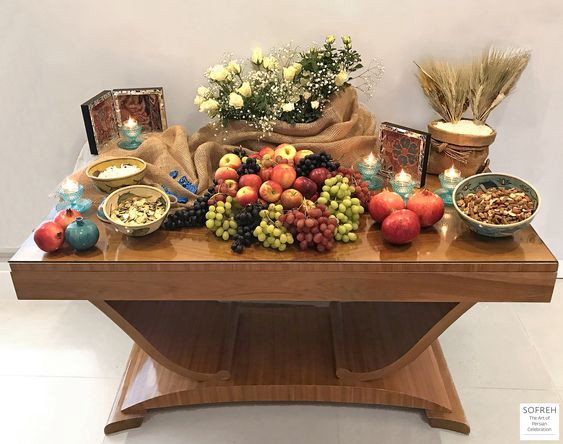
It is traditionally and universally considered by Zoroastrians to be the holiest day of the year and, as such, a time of great celebration, feasting, ritualization, and fellowship. Nowruz is celebrated with all things new: Clean house, clean self, new clothes, etc. along with, of course, lots of feasting, fire, ritual, and community gatherings. A recent practice of Haft-Sin (“Seven Things”) has developed where it is set up as a household altar containing items representative of the seven Amesha Spenta and the creations associated with them along with a mirror, sweets, flowers, a Zoroastrian book (usually the Gathas or the Khordeh Avesta), and sometimes even fish. Gifts are also exchanged, great fires are lit, and it is considered one of the most jovial times of the Zoroastrian year.
Khordad Sal:
This day celebrates the birth of Zarathushtra and is on the 6th day of the month of Khordad (hence the name) which places it at around March 26th on the Gregorian calendar. While not as celebrated in the Zoroastrian diaspora, it is nonetheless still celebrated amongst Iranian and Indian Zoroastrians as a day of both remembrance and celebration of Zarathushtra and his life.
Some Zoroastrians consider this to be the final day or, at least, the beginning of the end for Nowruz celebrations and thus for the Zoroastrian holy season. Celebrations include feasting, prayers, reading of the Gathas and stories/myths of the life of Zarathushtra, and the making of resolutions especially to live an Ashavic life like that of Zarathushtra.
Why is the Zoroastrian Holy Season important?
Zoroastrians can be prone to forgetting their holy days and festivals though, admittedly, we have a lot. Frequent debates about how “truly Zoroastrian” a holiday is, how something or another is not “historical” or “Gathaic” can distract from the beauty of our festivals and the true meaning of why we celebrate them.
The Zoroastrian Holy Season is a time to come together as a community to celebrate, reflect, pray, worship, honor, and live lives worthy of the blessings of Ahura Mazda, the Yazata, our ancestral Fravashis, and all other divinities.
It is the opinion of the author that the Zoroastrian Holy Season is the most important time of the year for a Zoroastrian and it should be taken seriously but part of that seriousness means engaging, as seen in the descriptions above, in alternating solemn pious activities and absolutely festive frivolity with each other. We are called to love and enjoy life and the material realm that we’re in so that our wonderful experiences are carried with us to enrich the spiritual realm and these days help us do that with one another. We are unique in that our holiest season is not one of endless mourning or scriptural fear or even of ascetic practice but rather of fun, feasting, and contemplation with each other as a global community of Ashavans. Together, as Ashavans, let us welcome the “New Day” and the new year, along with the glorious Fravashi, and toast to a better life, a stronger, diverse, and growing Zoroastrian community, and to the continuing perfection and care of our beautiful world.
Mehregan (also known as Jashan-e Mehr) usually occurs in the first week of October, depending on the alignment of the Solar Hijri calendar used officially in Iran and the Fasli calendar used by many Iranian Zoroastrians. This alignment occurs when the day of Mehr occurs in the month of Mehr according to these calendars. It is a multi-faceted holy festival that celebrates the Yazata Mithra (also known as Mihr or Mehr), our divinity and hypostasis of promises, friendship, relationships, and covenants that appears in most Zoroastrian scriptures from the Gathas of Zarathushtra onwards, along with the commemoration of other stories important to the Zoroastrian tradition. It is also the Zoroastrian equivalent of the Autumn Equinox, which traditionally occurs on September 21 or 22 in the Gregorian calendar.
How Was It Celebrated In the Past?
Mehregan was usually celebrated by Zoroastrian communities in both pre-Islamic and Pahlavi times to commemorate the end of the harvest and the beginning of the Winter season. Records of its celebration have been noted by ancient and medieval authors as having occurred in pre- and post-Islamic times in not just the core of the Iranian lands but also in Yemen, Egypt, China, India, and more. The associations with Mithra were detailed as a holy reminder of our mutual promises and duties with the divine reflected by a good harvest and sustenance for the coming Winter watched over by Mithra and Ahura Mazda.
Mehregan was a time of grand celebration considered even on the same level as Nowruz with the amount of pageantry and glorification. The imperial courts in Persepolis connected the holy day with tax and tribute collection; thus, great feasts and spectacles were assembled as nobles, priests, tributaries, and a wide range of denizens of the Persian Empires brought grand gifts to honor both the Shah and the Yazata Mithra. Those who could afford it would give vast amounts on this day to the poor and disadvantaged and even provided them with new homes, great feasts, and the like. Through this, gift-giving and charity became crucial components of the celebrations that continue to this day.
How Is It Celebrated Today?
Mehregan is celebrated with great joy not just in Iran and other Iranian-adjacent countries but also internationally wherever the Iranian diaspora and Zoroastrians are to be found. On this day, Zoroastrian clergy traditionally organize Jashans, celebrations of thanksgiving, and provide prayers and blessings to the laypeople. New clothes are gifted and worn, and a celebratory table-altar is set up in Zoroastrian households, community centers, shrines, and temples. This table is decorated lavishly and traditionally includes a Zoroastrian scripture (The Avesta, the Gathas, the Khordeh Avesta, etc.), an incense burner or small fire (usually fed with espand seeds and frankincense), and a mirror as the primary objects. Other items include marjoram, sormeh-dan eyeliner (containing kohl), various flowers and fruits, tasty sweets and nuts, silver coins or other currency, lotus seeds, and some sort of fragrant water or juice (such as rosewater or pomegranate juice).
The central household ceremony usually consists of the entire household and its guests standing in front of the altar table facing the mirror. Here, prayers and hymns are offered, followed traditionally by the drinking of either pomegranate juice or the Iranian drink sharbat and the application of the kohl from the sormeh-dan, with both being considered blessings against unvirtuous forces (in traditional Zoroastrian communities, this can mean the forces of Ahriman, the Evil Eye, and other such cursed actions) and to bring good luck. Seeds of various kinds are thrown all around in joyous and holy frivolity as the household and its guests embrace and exchange gifts.
What Lessons Can We Learn From Mehregan?
Zoroastrians of all stripes can see Mehregan as a day to renew our covenant with Ahura Mazda and all the Yazatas and our covenants of friendship, love, and duty to our loved ones and each other as a community. It is a festival where we celebrate all the great bounties provided to us and each other and how it is our duty to help one another and those less fortunate than us who have been unable to access those bounties. As Zoroastrians who love both our feasting and our charitable acts, Mehregan can be a day for both where we invite the community to our households and temples and make sure to provide food, drink, gifts, joy, fraternity, and love to not just our fellow sworn brethren on the Path of Asha but also to the rest of the world.
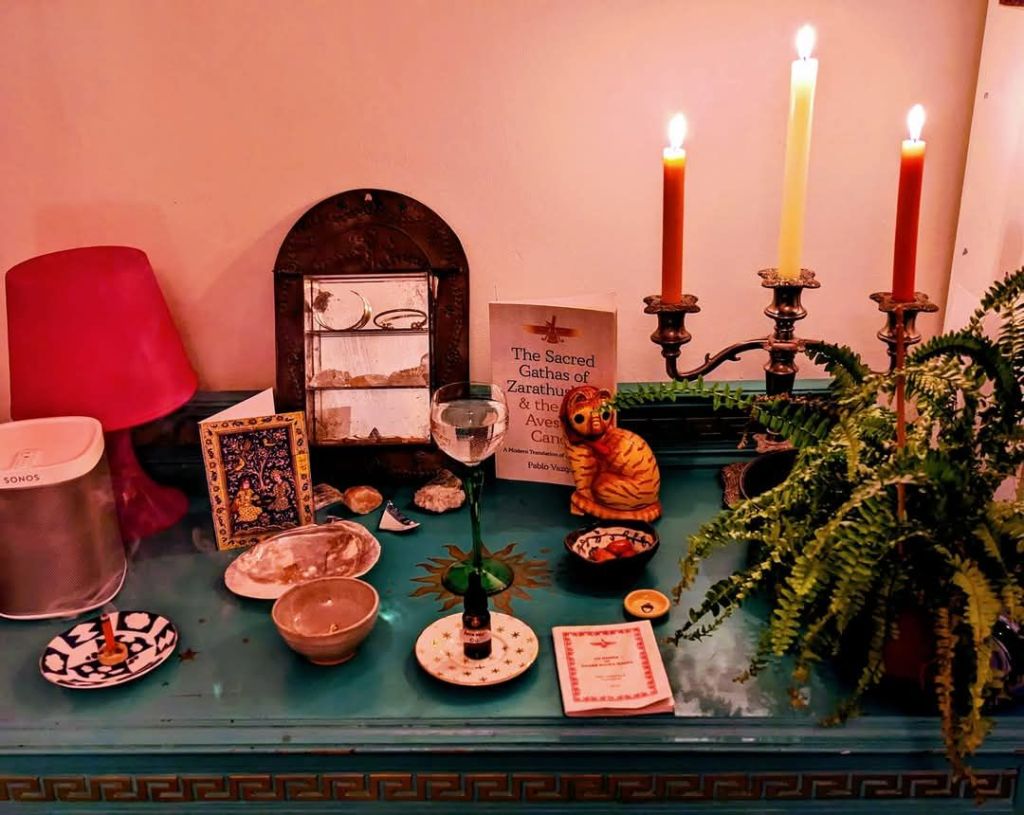
I’ve been seeing a lot of needless e-yelling about making Nowruz “less Islamic” by setting up the Haft table without using “Arabic words or letters”. Critiques aside regarding separating cultures that have been intertwined for over a thousand years now, I suggest instead that, if you want a quite Zoroastrian Haft table, you follow the model I used since I’m not Iranian and thus have never set up a Haft-Seen table but rather a Haft-Amesha table. Basically, an item is included to represent the purview of the seven Amesha Spenta as below:
Spenta Mainyu (Humanity): Gathas, Shahnameh, or any other Zoroastrian-related text. A mirror can also be added.
Vohu Manah (Animals): Feathers, Milk, or anything else representative of Animals
Asha Vahishta (Fire): Candle, Divo, Incense, or anything that burns
Kshasthra Vairya (Metals/Minerals): Silver, Gold, Salt, Crystals, or any other such Metals and Minerals
Armaiti (Earth): Dirt, Moss, Terrarium, or anything that is Earth-y.
Haurvatat (Water): Glass of Water, Fishbowl, Ice, or anything composed of Water
Ameretat (Plants): Flowers, Trees, Grass, Fruits, Vegetable, or anything that grows from the Earth. Plant-based oils also work.
I hope this helps provide an alternative. Happy Nowruz!
First off, if you wish to learn about Yalda, especially from a Zoroastrian perspective, please read my article written for the WZO here. It will help fill you in on the meanings, misconceptions, histories, theologies, and methods of celebration for this fantastic holiday.
I really encourage all of you, my fellow Zoroastrians, to celebrate Yalda Night/Chelleh Eve (on the 21st of December in 2022 in the northern hemisphere and tomorrow by the writing of this article) in whatever way you can even if you just spend it being gregarious with your household or just online in video calls. I am part of an initiative amongst Zoroastrians working to make it our distinct December festival of celebration, feasting, and gift-giving as the Christians have Christmas and the Jewish community has Hannukah. This way, we can join in the celebrations of our neighbors without forsaking our own and truly bringing some joy to these Winter days! I won’t discourage you from celebrating the various grand Winter festivals of other faiths, but why not be a proud Zoroastrian and give Yalda Night/Chelleh Eve a try this year and those following? I’m sure your kids and other small family members, if you have them, will love it and they’ll have something to tell their friends of other faiths about!
If you can be public about it, please do so, though I understand that there are those who can’t because of political or family circumstances. Please, on social media, post photos of your celebration, feasts, music, art, and be sure to give gifts to your loved ones, neighbors, and friends on this day even if it’s just a tasty pomegranate.
This article will help by providing some suggestions on how to best celebrate this holiday no matter where you are in the world. Now, here are seven steps and suggestions to make your Yalda celebrations a fantastic one:
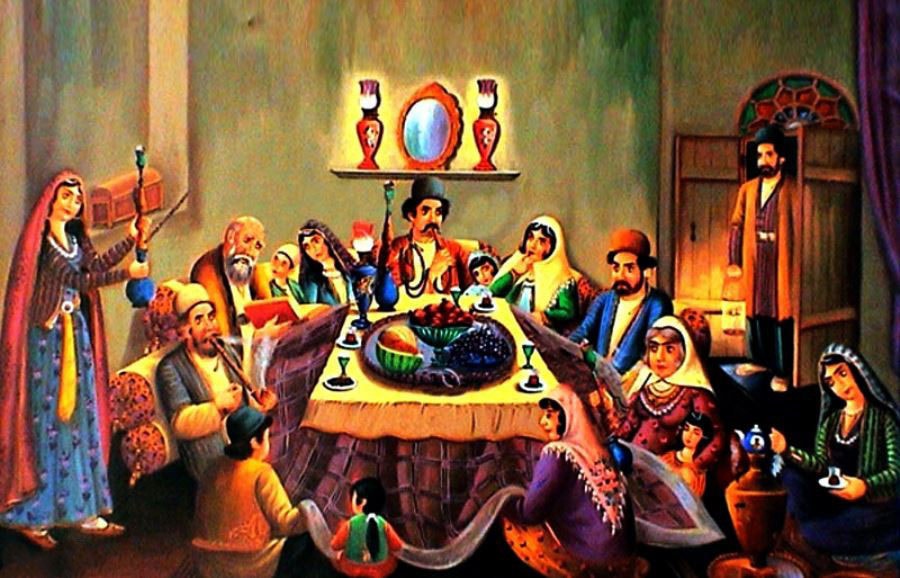
Prepare Your Table Most household Zoroastrian celebrations are usually held around a table and this is no exception. Get a table, whether your dinner table, your coffee table, an altar table, or, if you’re lucky to have one, a nice and warm Iranian corsi. Cover it in red and/or white cloths, candles, flowers, art, a portrait of Zarathushtra, and a copy of the Gathas and/or other Zoroastrian literature. I recommend also including other poetry and works of fiction from your household, works beloved by you and your loved ones. A fun thing to do is to ask guests to bring their own books to read from and share with their fellow guests. I recommend the Shahnameh, the grand epic of Iran packed full of our Zoroastrian mythologies, and acting out scenes together if possible!
Decorate! The purpose of Yalda is to banish the darkness and thoughts of sadness, misery, and all wretchedness. As such, you’ll want to decorate your household to reflect this! You can’t go wrong with candles and other fires, flowers, decorative fruits, brightly-colored banners & streamers, and all sorts of pretty lights. Perhaps light some incense or nice-smelling candles, get fun little party hats and/or garlands for guests to wear, and, of course, dress up for the occasion. Sometimes the best decor is the one you bring wearing on you!
Gather Your Loved Ones Friends, family, and good neighbors are always such a blessing so bring them all over to celebrate on the longest night with you! If you’re not the cooking type, this may be a good way to organize a potluck where everyone brings their own tasty dish and beverages to share. If you do cook, be mindful of any food allergies and requests from your guests and provide alternative options for non-drinkers, non-smokers, and the like. Not everyone will want to stay up late and that’s fine but make sure there are comfortable places to sleep for those that do. No doubt you and those brave folks that last the night will want somewhere soft to rest your head after all the festivities!
Play Music, Tell Stories, Pray Together, Read Poetry, and Dance! Ancient Zoroastrians would gather together on this night to bring in joy as much as possible. I’m not going to tell you how to do that as it’s a crucial part of our lovely human experience. However, historically, we have played music, told stories, read poetry, engaged in friendly competitions, danced the night away, and the like. In modern times, this can include watching your favorite movies together, making food as a family, playing all sorts of games whether analog or virtual, and like. A popular thing to do is to divine your fortunes for the following year by picking by opening the Gathas or another book important to you, closing your eyes, and picking a verse at random and seeing how your winter shapes up from there! The point is to maximize the joy so do that as you best see fit! Of course, don’t forget why we celebrate and try to pray together a little bit even if that prayer is just reading a section of the Gathas or a moment of silence to remember those who can’t be there to celebrate as well. It’s a joyous day but it’s also a sacred day and don’t forget that one of the guests in your celebrations is always Ahura Mazda, our greatest friend and companion, who revels in our joy.
Exchange Gifts Almost every Zoroastrian festival in pre-modern times involved some sort of gift-giving or another and Yalda is no exception. We’re surrounded in this time by so many other gift-giving holidays, secular and religious, and we shouldn’t be remiss to celebrate our own. Have a gift ready for each of your guests attending and encourage them to bring some as well. It doesn’t have to be something grand and can be as simple as the traditional gift: A pomegranate! Who’s going to turn down something so delicious, eh? If you’re at a loss, it’s always lovely to give something homemade like crafts, baked goods, and the like. Have friends that like to read? Set up a wrapped book box where it’s a mystery as to what they’ll get and have them pick one! Be sure to include your neighbors and non-Zoroastrian family and friends so that they know what Yalda is all about and spread the word about our wonderful celebrations. Nothing says they can’t be included so bring them in and be a good host which in itself is a fantastic gift.
Eat, Drink, and Be Merry! Ask any Zoroastrian and they can tell you we love to eat! We take food seriously and we boast some amazing cuisine from our traditional cultural communities. Prepare some traditional dishes from your culture and be sure to also include many fruits like pomegranates, watermelons, citruses, apples, nuts, and the like. Last, but not least, don’t forget the juices, wines, tea (lots of tea), and tasty sweet treats! At a loss as to what to serve for desserts? I personally recommend a large amount of Sholeh Zard, an absolutely delectable saffron rice pudding, and my favorite Persian dessert. Need a recipe? Don’t worry, click here and I’ve got you covered!
Stay Up As Late As You Can Our spiritual ancestors would party all the way until the sun, triumphant against the darkness, would blind them in the morning and then promptly sleep, so, if you have the energy and desire, try to stay up as late as you can and greet the dawn as they did. If anything, it makes for a fun competition of seeing who can stay up the latest! Perhaps have a prize ready for whomever succeeds? No doubt they’ll at least enjoy some tasty breakfast! Can’t stay up that late? Don’t worry, it may be fun to do but not all of us are cut out for it. Just enjoy your night the best you can, cuddle up to your loved ones or your favorite pillow if you’re celebrating alone, and enjoy a restful sleep and wonderful dreams when it hits you.
I hope all of that helps! Please post your celebrations on social media and share this article to encourage others to celebrate.
Happy Yalda Night/Chelleh Eve, my fellowZoroastrians, and may it be a joyous one!


 Mazdayasni Online